
Retrieval Workflow#
The retrieval workflow starts from a TOML project and ends with normalized data
records available to the rest of the run. The same pattern works for
[workflow].mode = "overview" and for solver workflows that need data-backed
geometry, forcing, observations, or boundary conditions.
Minimal public-data stack#
This example uses public providers for a French basin. It is intentionally small enough to read in one pass:
[simulation.time]
start_datetime = "2018-01-01"
end_datetime = "2020-12-31"

[data]
project_crs = "EPSG:2154"
inference_mode = "strict"
types = ["dem", "geology", "hydrography", "hydrometry", "piezometry", "recharge"]

[[data.dem.sources]]
source = "ign_geoplateforme_dem"
dataset = "bd-alti"
resolution_m = 25.0
extent = "watershed"

[[data.geology.sources]]
source = "brgm_1m"
extent = "watershed"

[[data.hydrography.sources]]
source = "bdtopage"

[[data.hydrometry.sources]]
source = "hubeau"
product = "QmnJ"
extent = "watershed"
require_observations = true
fallback_search_radius_km = 10

[[data.piezometry.sources]]
source = "hubeau"
extent = "watershed"
product = "level"

[[data.recharge.sources]]
source = "sim2"
extent = "watershed"
Read it from top to bottom:
typesis the explicit family list.project_crsis the target CRS for normalized project data.extent = "watershed"asks compatible providers to use the project watershed or study-area extent.Date windows come from
[simulation.time], or from[overview]in overview mode. A family section such as[data.hydrometry]declares one only to override that inheritance.hydrographyproviders do not expose anextentfield in their source config; the runtime uses the geographic context passed to the hydrography manager.
What the stack produces#
On the Nancon reference basin, the same kind of declaration produces visible data diagnostics before any solver is executed.


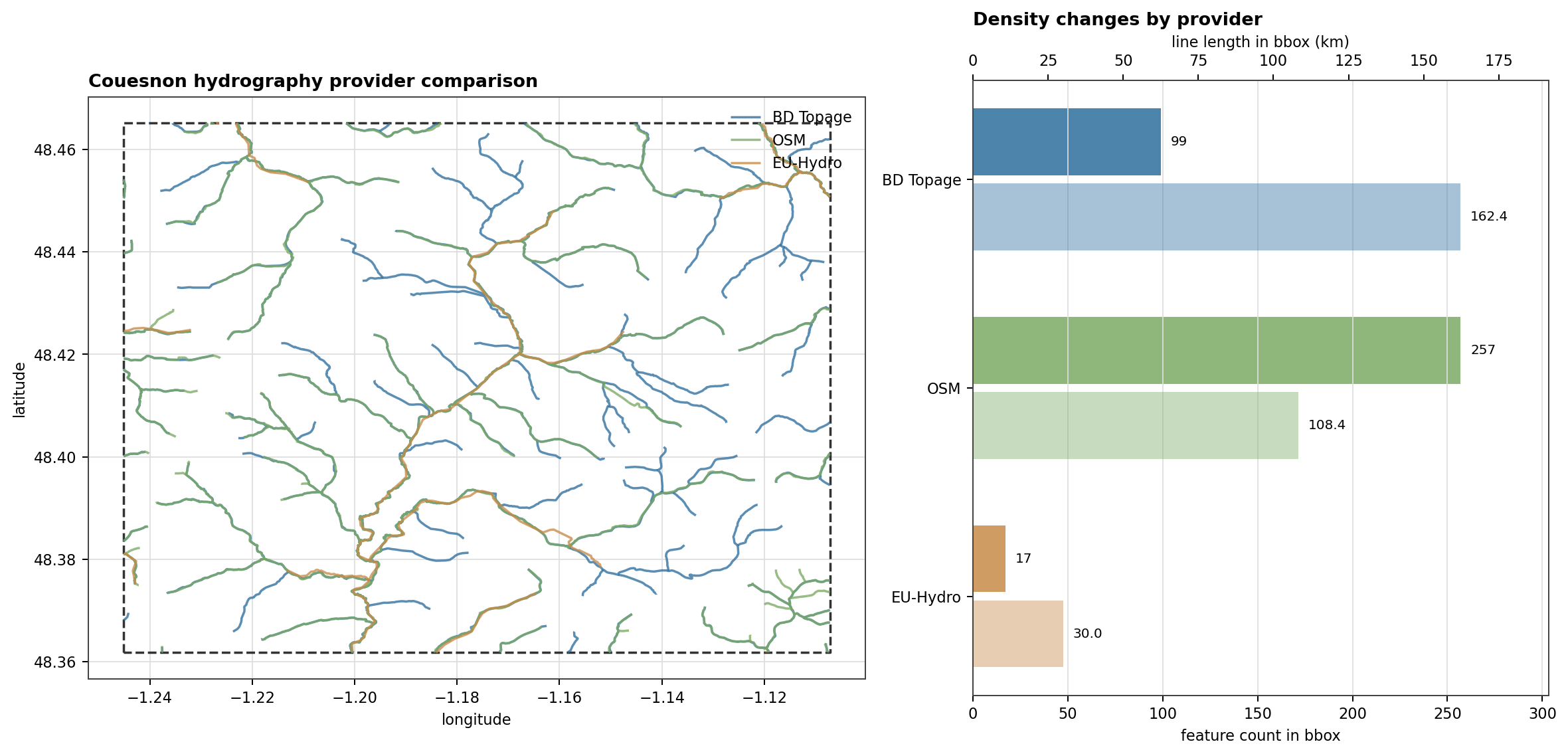
Fig. 26 The provider choice itself can change the loaded network. The Couesnon replay compares BD Topage, OSM, and EU-Hydro after clipping them to the same bbox, which is the kind of check to do before selecting a hydrography source.#

Active families and inference#
data.types is the user’s explicit contract. The planner can also infer
families from other model sections:
Runtime clue |
Inferred family |
Why |
|---|---|---|
|
|
The domain asks for geology-backed zones. |
|
|
Stream boundary conditions need a river network. |
|
|
Coastal boundary conditions need sea-level data. |
Use inference_mode = "warn" while exploring. Use
inference_mode = "strict" when the TOML should fail if an inferred family
does not have an explicit section. geology is the exception: it can be
defaulted when inferred.
Spatial filters#
Most API-backed spatial sources need one of these selectors:
Selector |
Typical families |
Use it when |
|---|---|---|
|
DEM, geology, Hub’Eau families, SIM2 forcing |
The project has a resolved watershed and you want the basin window. |
|
DEM, geology, Hub’Eau families, SIM2 forcing |
You want the larger project context when available. |
|
DEM, geology, point/time-series families, gridded forcing |
A local polygon or raster mask is the authoritative spatial filter. |
|
Hydrometry, piezometry, water quality, climate-style point sources |
The stations are known and should not be discovered by bbox. |
|
Intermittency |
ONDE discovery should use French department codes. |
Temporal filters#
[simulation.time] is the date declaration of a run file. A family block
that declares no window inherits it, so the dates are written once:
[simulation.time]
start_datetime = "2020-01-01"
end_datetime = "2020-12-31"

[[data.hydrometry.sources]]
source = "hubeau"
extent = "watershed"
A window declared on the family block overrides that inheritance, and is reused by all sources in that family:
[data.hydrometry]
date_start = "2010-01-01"
date_end = "2020-12-31"

[[data.hydrometry.sources]]
source = "hubeau"
extent = "watershed"
Declare it only to fetch a window wider than the simulation, typically to download once a chronicle that several runs of different lengths will reuse from the cache. A narrower window starves the run instead. The two bounds must be declared together: a half-declared window is a configuration error, not a partial override.
In overview mode there is no [simulation.time]: [overview].date_start
and [overview].date_end carry the window, and the family blocks inherit
from it under the same rule.
lake_geometry, lake_bathymetry and lake_abacus are static and carry
no window at all.
The Python API reverses the relation in one case: when a Project has no
[simulation] block at all, [data.recharge].date_start /
[data.recharge].date_end become the simulation window
(hydromodpy.project.phases.ensure_simulation_block). A TOML run file always
goes the other way.
Running and inspecting#
Use an overview workflow when you want to audit data without a solver:
hmp run examples/projects/05_nancon_data_overview/config_overview.toml
After a run, inspect the workspace data catalog:
hmp data ls --workspace ~/hydromodpy
hmp data ls --workspace ~/hydromodpy --variable hydrometry
hmp data check --workspace ~/hydromodpy
Use force_refresh = true only on the source that should bypass the cache:
[[data.recharge.sources]]
source = "sim2"
extent = "watershed"
force_refresh = true
Use hmp run --frozen when the run must not download or ingest anything that
is not already present and locked.
Observation panels#
Once the data is loaded, the overview workflow can also render the observation chronicles that later serve comparison or calibration work.


Failure triage#
If a provider says a bbox is missing, add
extentormask_pathon a source that supports it.If a time-series provider returns no stations, try explicit
station_idsor a smallfallback_search_radius_km.If a custom vector geology file fails, check that
code_fieldnames an existing attribute column.If a gridded custom forcing has wrong magnitudes, set
source_unitinstead of editing solver parameters to compensate.
See also#
[data] DataManagersConfig for every field named above, including
types,inference_mode, andextent.Custom Data for the same retrieval pattern using
source = "custom"instead of a public provider.Cache And Lockfiles for what
force_refreshandhmp run --frozendo to the workspace cache this workflow populates.Troubleshooting for errors that are not covered by the failure triage above.
Data Managers And External Dependencies for the activation and inference rules implemented by the planner.