
Precipitation#
precipitation loads liquid, solid, or total precipitation forcing. It is a
meteorological input for hydrological preprocessing and a diagnostic context
for recharge and runoff interpretation.
Accepted sources#
Source |
Use when |
Source page |
|---|---|---|
|
A local precipitation raster, NetCDF file, or station-derived series is authoritative. |
|
|
SIM2 gridded precipitation should be retrieved over the project period. |
Minimal example#
[data.precipitation]
date_start = "2000-01-01"
date_end = "2002-12-31"

[[data.precipitation.sources]]
source = "sim2"
components = ["total"]
extent = "watershed"
All field definitions, types, and defaults live in the generated reference: [data] DataManagersConfig.
Loaded shape#
PrecipitationManager (hydromodpy.data.variables.precipitation.manager, in the
hydromodpy.data layer) returns one of two record shapes depending on the source:
custompointed at a directory of station files returns a list ofPointRecord: one entry per station, each carrying adatetime/valuetime series, a start and end date, and the resolved unit.custompointed at a single.ncor.tiffile, and everysim2source, returns a list ofFieldRecord: a gridded dataset over a bounding box and CRS, with the source period asdate_start/date_end. SIM2 returns oneFieldRecordper requested component.
Both shapes are converted to the internal unit mm/day before reaching downstream code,
whatever unit the source file declares or the SIM2 API returns.
Visual check#
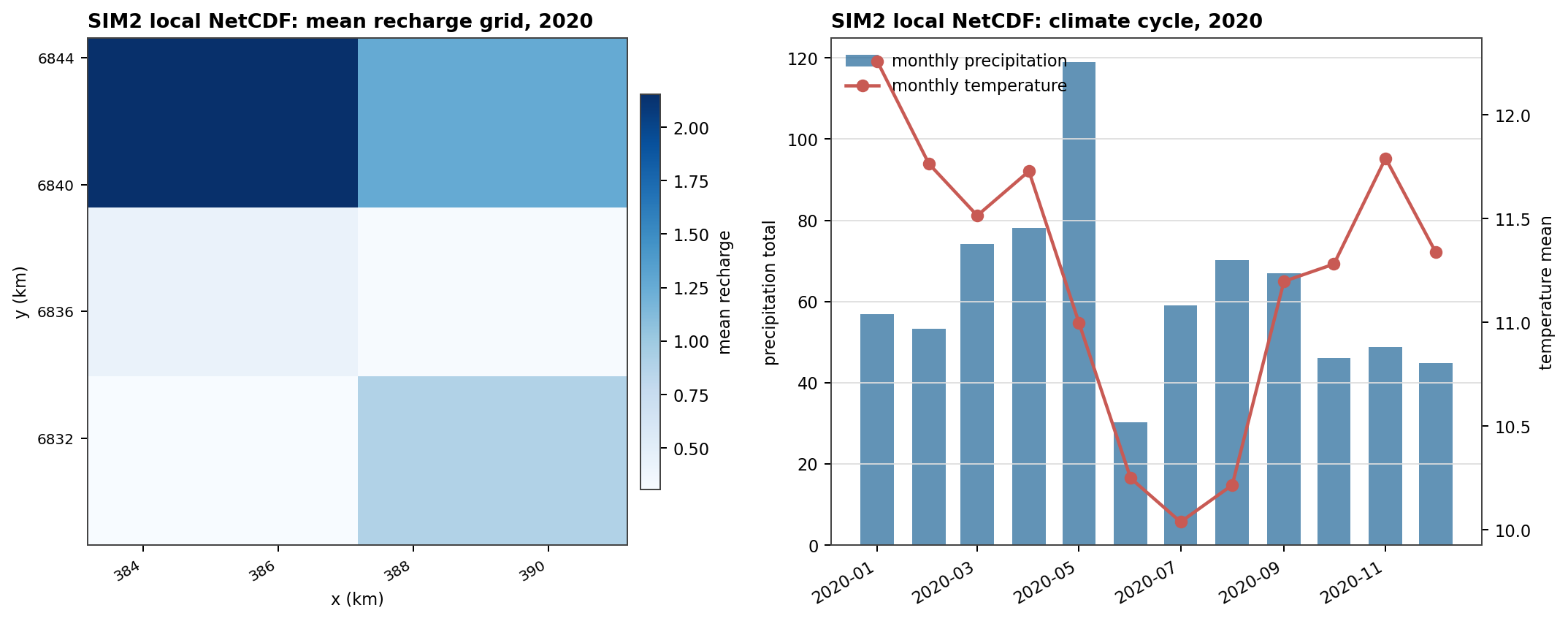
Fig. 83 The right panel shows the kind of monthly total that should be inspected for SIM2 precipitation before it is compared with recharge, runoff, or solver budget terms. See Runs And Figures for how this figure is regenerated.#
Downstream uses#
hydrological preprocessing for PyHELP-driven recharge (daily total precipitation, one of the D4 weather inputs);
the shared forcing bridge used to combine recharge, precipitation, ETP, and temperature sources into homogeneous inputs;
open-water rainfall applied directly to lake surfaces alongside ETP-derived evaporation, in the lake meteorological forcing step;
climatic summaries and reporting alongside Recharge, ETP, and Temperature.
Precipitation Source: custom#
Use source = "custom" for local precipitation rasters, NetCDF files, or
station-derived series.
[[data.precipitation.sources]]
source = "custom"
path = "data/precipitation/precipitation.nc"
source_unit = "mm/day"
The path field accepts either a directory of station
location and chronicle files, or a single .nc/.tif file; which one decides the loaded
shape described above.
Operational checks:
set source_unit when file metadata do not carry explicit units;
check period coverage, units, and spatial support before the data are used in hydrological preprocessing, and check which signal the file holds:
componentsis read by thesim2loader only, so acustomfile is taken as written;mask_path can filter stations or clip a gridded source to a project mask;
station_ids restricts loading to an explicit station list when the source directory holds more stations than needed.
Precipitation Source: sim2#
Use source = "sim2" to retrieve SIM2 precipitation fields.
[[data.precipitation.sources]]
source = "sim2"
components = ["liquid", "solid", "total"]
extent = "watershed"
components selects which precipitation signal is loaded from the provider: liquid rain, solid snow, or their sum. One record is returned per selected component. extent selects the bounding box used for the request: the delineated watershed, or the broader study area.
Operational checks:
inspect the climatic summary to verify that the requested period and selected components are available;
set force_refresh to bypass the cache when the SIM2 payload needs a fresh download.
Provider replay#
Fig. 84 The monthly precipitation panel is the first provider replay to inspect before comparing precipitation with recharge, runoff, or solver budgets. The full replay case is described in Provider Replay Cases.#