
Intermittency#
intermittency loads flow-state observations such as ONDE-style dry or
flowing states. It is useful for diagnosing active network behavior and for
qualitative comparison with simulated drainage activation.
Accepted sources#
Source |
Use when |
Source page |
|---|---|---|
|
Local flow-state observations are authoritative. |
|
|
Hub’Eau/ONDE-style public intermittency observations should be retrieved. |
|
Minimal example#
[data.intermittency]
date_start = "2010-01-01"
date_end = "2020-12-31"

[[data.intermittency.sources]]
source = "hubeau"
extent = "watershed"
Visual check#

Local deterministic run#
The repository also includes a local intermittency-only case under
hydromodpy/data/variables/intermittency/cases. It is useful for explaining
the custom file convention without relying on an online Hub’Eau request.
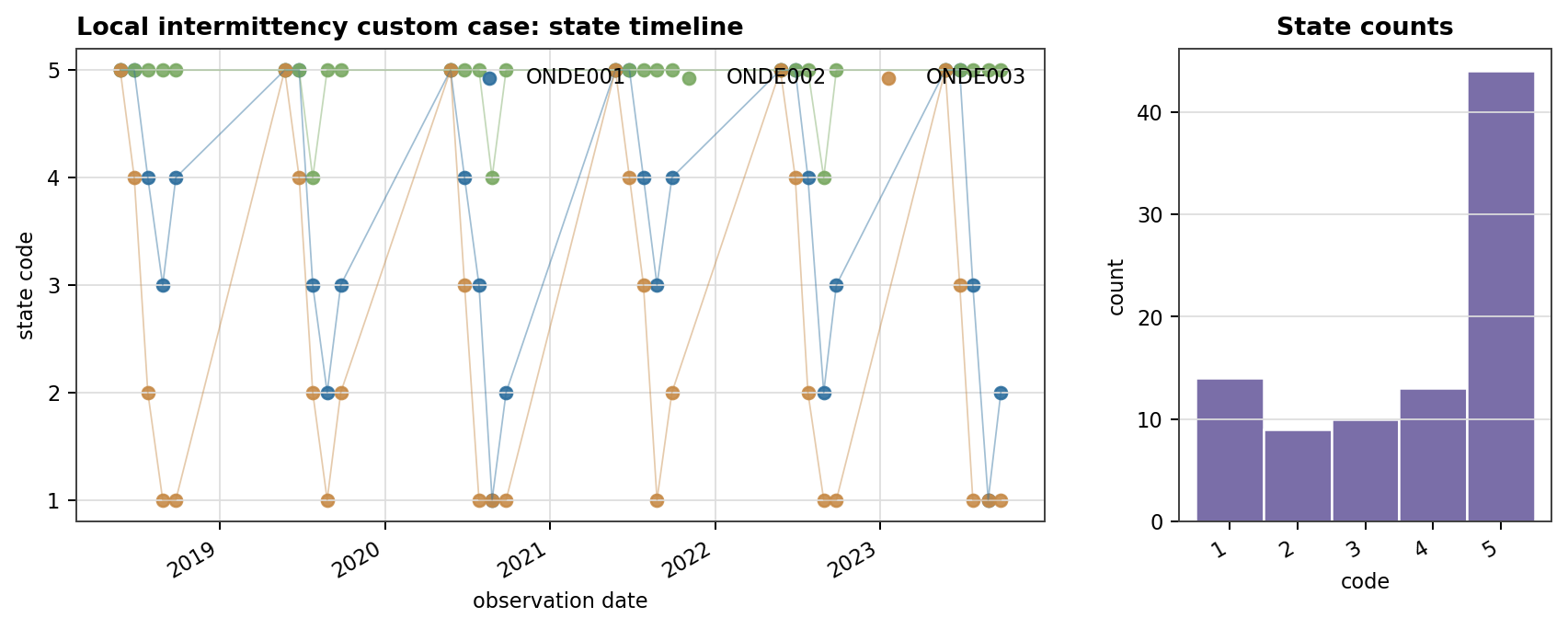
Fig. 75 The timeline checks whether station identifiers, dates, and categorical state codes were loaded as intended. The histogram makes the balance between dry, transitional, and flowing states visible before the data are compared with a simulated active network.#
Downstream uses#
active-network interpretation;
qualitative validation of drainage/seepage behavior;
seasonal low-flow diagnostics.
Intermittency Source: custom#
Use source = "custom" when local flow-state observations should be
ingested from project files.
Minimal example#
[[data.intermittency.sources]]
source = "custom"
path = "data/intermittency"
col_id = "station"
col_datetime = "date"
col_value = "state"
Operational checks#
Document the state coding used in the local file.
Confirm that station coordinates are available or discoverable.
Do not compare state observations to simulated fluxes until the thresholding rule has been stated explicitly.
Intermittency Source: hubeau#
Use source = "hubeau" to retrieve public flow-state observations.
Minimal example#
[[data.intermittency.sources]]
source = "hubeau"
extent = "watershed"
code_departement = ["35", "53"]
Operational checks#
Department filters can keep discovery predictable.
Check observation dates against the simulation or comparison window.
The data are categorical observations, not discharge values.
Provider replay#
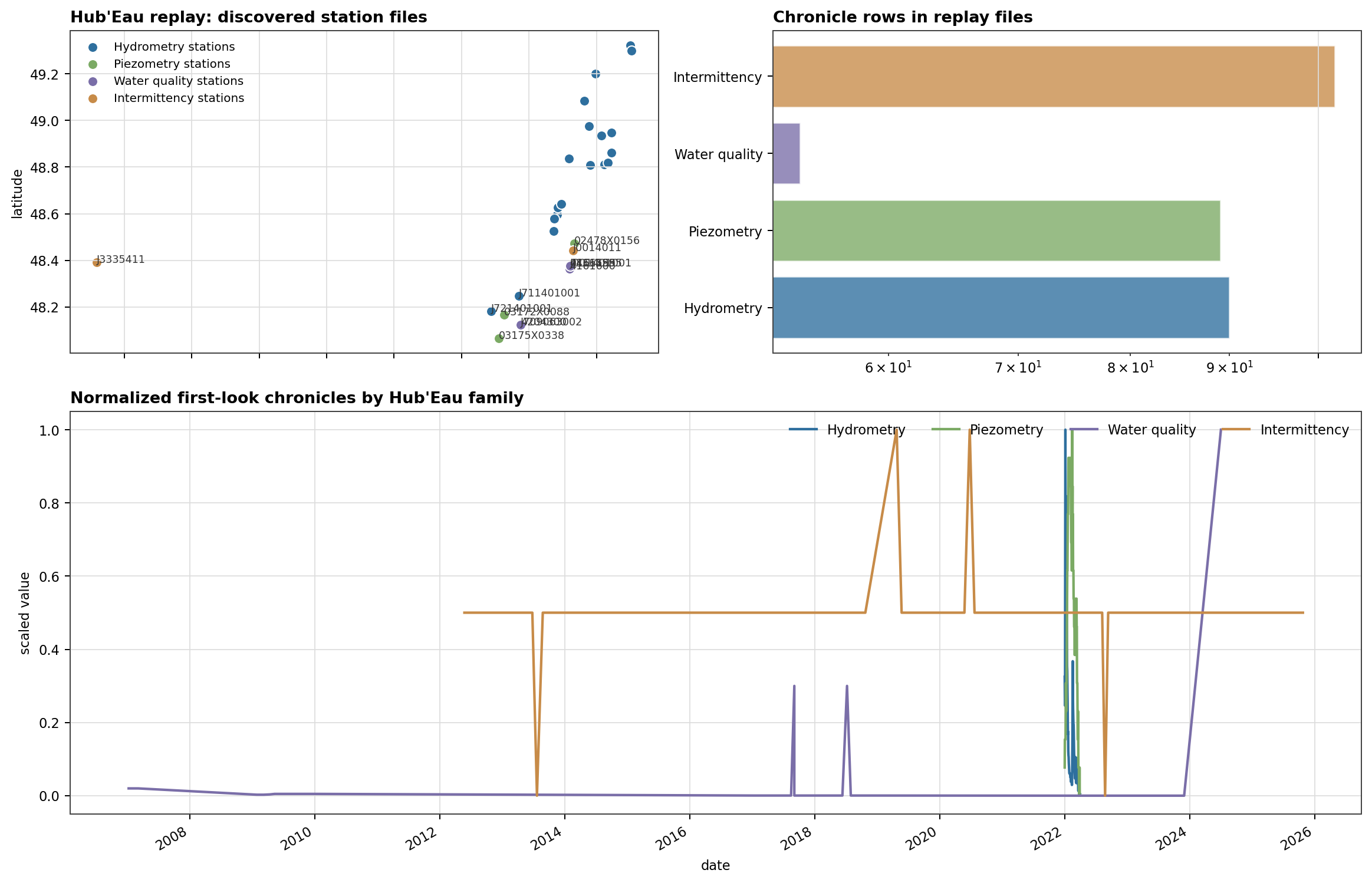
Fig. 76 The intermittency part of the Hub’Eau replay shows categorical state values, not a continuous hydrological flux. That distinction should be visible before ONDE-style data are compared with a simulated active network.#
See also#
The simulated active network these states are compared against has a dedicated
calibration output: set support = "network" in
[calibration] CalibrationConfig to score a simulated release_flux
field against a mapped stream network, the same active-network comparison this page’s
local run and Hub’Eau replay show qualitatively. observation.points remains the way to sample point-based variables when the
comparison is not network-wide. Calibration Workflow documents the
full campaign. The other observation families are Hydrometry, Piezometry,
and Water Quality.